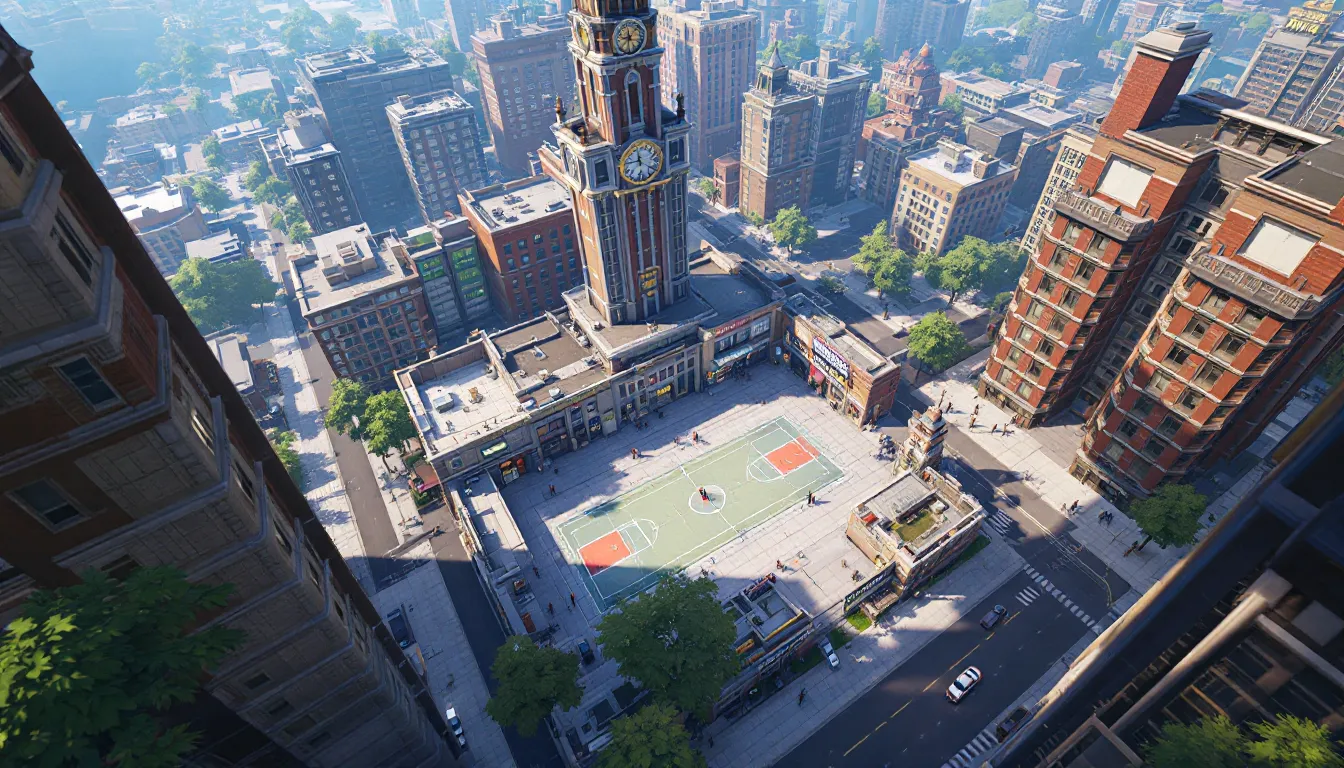
Few locations in battle royale history have commanded the same reverence, and terror, as Tilted Towers. The mere mention of this POI can spark nostalgia in veteran players or dread in those who’ve been third-partied in its chaotic streets. Since its debut in Chapter 1, Tilted Towers has been the crucible where reputations are forged and squad wipes become montage material.
This guide breaks down everything players need to know about Tilted Towers: its turbulent history through multiple map changes, the layout and loot distribution that made it a hot drop, and the combat strategies that separate survivors from spectators. Whether someone’s looking to understand why this POI became legendary or refine their approach to dominating its verticality and close-quarters chaos, this is the resource.
Table of Contents
ToggleKey Takeaways
- Tilted Towers is Fortnite’s most intense early-game proving ground, featuring 15–25 player encounters within the first minute due to its central location and dense urban layout with abundant loot spawns.
- Mastering Tilted Towers requires prioritizing weapon acquisition, building 100+ materials, and establishing high-ground control in the first 60 seconds before rotating to adjacent structures or escaping mid-fight pressure.
- Trump Tower and Clock Tower are the highest-value loot destinations in Tilted, offering 10–12 and 5–6 chest spawns respectively, though competition for these buildings is intense and requires quick looting followed by immediate repositioning.
- Audio awareness and vertical building skills are critical survival mechanics in Tilted’s tight corridors and multi-story fights, where tracking footsteps and managing edits separate skilled players from frequent spectators.
- While Tilted Towers excels as a mechanical training ground and content creation hub, competitive players typically avoid it in tournaments due to high early-game volatility, unpredictable third-parties, and lower consistency compared to medium-traffic POIs.
- Knowing when to rotate out of Tilted—triggered by elimination count, material depletion, or zone positioning—determines whether survival translates into Victory Royales or forced late-game rotations with depleted resources.
What Is Tilted Towers in Fortnite?
Tilted Towers is a named point of interest (POI) in Fortnite Battle Royale, characterized by its dense urban layout of multi-story buildings, abundant loot spawns, and relentless early-game combat. Located in a central position on the island map, it features a cluster of high-rise structures, including the iconic Clock Tower and what the community dubbed “Trump Tower”, a tall L-shaped building that dominates the skyline.
The POI functions as a high-risk, high-reward landing zone. Players dropping here encounter immediate combat, often facing 15-25 opponents within the first minute. The vertical construction and tight corridors create a combat environment unlike anywhere else on the map, demanding sharp building mechanics, quick edits, and instant decision-making.
Tilted Towers isn’t just a location, it’s a proving ground. Landing here signals confidence (or recklessness, depending on who survives). The density of chest spawns, floor loot, and ammo boxes makes it possible to walk out fully kitted with shields, a solid loadout, and enough materials to contest mid-game rotations. But most players don’t walk out. They spectate their squadmates while contemplating better landing choices.
The History and Evolution of Tilted Towers
Original Tilted Towers (Chapter 1)
Tilted Towers first appeared in Chapter 1, Season 2 (Patch v.2.2.0, January 2018) and immediately became the most contested drop on the map. Epic Games had never introduced such a dense urban POI before, and the player base responded by converging on it en masse, sometimes half the lobby would land there, turning the early game into absolute pandemonium.
The original design featured roughly 15 distinct buildings, including the Clock Tower, Pawn Shop, Big Bertha (the brick building), No-Sweat Insurance, and multiple apartment complexes. Chest spawn rates were generous, upwards of 30+ possible chest locations, and the central location meant favorable rotations regardless of zone placement. Many players consider this the golden era of tilted towers fortnite, when the POI defined the aggressive meta.
From Season 2 through Season 8, Tilted remained largely unchanged, cementing its status as the heart of the map’s action. Streamers built their brands on Tilted hot drops, racking up double-digit elimination games while thousands watched.
The Destruction and Tilted Town Era
Everything changed in Chapter 1, Season 8 when the volcano event destroyed several buildings, leaving parts of Tilted in ruins. Then, in Season 9, Epic replaced the entire POI with Neo Tilted, a futuristic reimagining with floating platforms, neon aesthetics, and a completely different flow. The community response was mixed at best. Neo Tilted lacked the gritty verticality and familiar rotations that made the original special.
Season X brought another transformation: Tilted Town, a Wild West-themed variant where building and harvesting were disabled within the POI boundaries. This radical change forced pure gunplay and positioning, eliminating Fortnite’s signature building mechanic entirely. While novel, it didn’t capture the essence of what made the original Tilted iconic. Players adapted, but many longed for the return of the classic layout.
Neo Tilted and Tilted Towers’ Return in Chapter 3
After Chapter 2 passed without any version of Tilted, Epic finally brought back the original Tilted Towers in Chapter 3, Season 1 (December 2021). The POI was faithfully recreated with updated graphics and minimal layout changes, triggering massive celebration across the community.
The return wasn’t just nostalgia-driven, it reintroduced a playstyle that had been absent for years. Early games once again saw 20+ players converging on those familiar streets, and the chaos that defined Chapter 1’s aggressive meta came roaring back. Epic maintained the POI through subsequent Chapter 3 seasons, though loot pools and chest spawn mechanics evolved with each update.
As of Chapter 5 (current as of March 2026), Tilted Towers remains one of the most recognized locations in Fortnite’s history, even when temporarily vaulted. Its legacy influences map design philosophy and player expectations for high-intensity POIs.
Why Tilted Towers Became the Most Popular Landing Spot
High-Density Loot and Quick Action
Tilted Towers packs more loot per square meter than almost any other POI. The original Chapter 1 version featured 34 possible chest spawns plus dozens of floor loot locations, ammo crates, and material sources. This density means players can gear up without extensive looting rotations, assuming they survive the initial bloodbath.
The quick action is equally appealing. Players seeking to improve mechanical skills or warm up before competitive sessions choose Tilted because combat starts immediately. There’s no 90-second farming phase or mid-game lull. It’s instant third-parties, vertical fights, and constant pressure from multiple angles. For content creators and aggressive players, that’s exactly the point. According to various player behavior analyses, Tilted consistently attracted the highest early-game player concentration of any named location.
Even players who don’t typically enjoy hot drops occasionally land Tilted just for the adrenaline rush. The POI delivers action density that’s become synonymous with Fortnite’s high-skill ceiling.
Central Map Location and Rotation Advantages
Beyond loot, Tilted’s geographic positioning offers massive strategic value. Located near the map’s center in most iterations, it provides favorable rotation options regardless of first-zone placement. Players leaving Tilted rarely face lengthy repositioning or forced early rotations through contested terrain.
This central location also makes Tilted a natural mid-game crossroads. Even teams that land elsewhere often rotate through or near Tilted, creating opportunities for third-parties and mid-game eliminations. The vertical structures provide sightlines across multiple POIs, letting teams gather information before committing to rotations.
In competitive formats, central POIs typically see less traffic due to the risk-reward calculation shifting toward consistency. But in public matches and Arena modes below Champion division, Tilted’s central position compounds its popularity, it’s both the destination and the highway.
Skill Development and Competitive Practice
Tilted Towers became an unofficial training ground for mastering core techniques. The POI’s design forces players to develop:
- Vertical building and editing through multi-story construction
- Close-quarters tracking in tight hallways and stairwells
- Audio awareness to track multiple opponents across floors
- Resource management when material counts run low mid-fight
- Decision-making speed under constant third-party pressure
Many professional players credit hundreds of Tilted drops with accelerating their skill progression. The volume of fights compressed into 2-3 minutes provides more combat practice than 20 minutes of rotating through less populated areas. When IGN covered competitive training methods, multiple pros cited hot-dropping as essential for maintaining mechanical sharpness.
The mentality shift matters too. Players who consistently survive Tilted develop confidence in chaotic situations that translates to late-game tournament performance. There’s a reason “I survived Tilted” became a badge of honor in the community.
Map Layout and Key Landmarks Within Tilted Towers
The Clock Tower
The Clock Tower stands at Tilted’s northwestern edge, serving as both a navigational landmark and strategic position. This tall brick structure contains multiple floors with chest spawns, though its value lies more in sightlines than loot density.
Players who secure the Clock Tower early gain visual dominance over the entire POI. The elevated position allows for third-party sniping opportunities and information gathering as fights develop below. But, the structure’s isolation makes it vulnerable, opponents can easily block rotation with builds, trapping players inside.
Smart players loot the Clock Tower quickly then reposition before getting boxed in. It’s an excellent landing spot for duos or squads who can support each other’s rotation out, but solo players often find themselves spectating after getting collapsed on from multiple angles.
Trump Tower and Pawn Shop
Trump Tower (the tall L-shaped building officially unnamed but universally recognized) sits in Tilted’s center and defines the POI’s verticality. Five stories of apartments, each with multiple rooms and chest spawns, make this the highest-value single structure in Tilted.
Landing on Trump Tower’s roof gives first access to top-floor loot, but it’s a declaration of intent, everyone knows you’re there, and multiple teams will contest. The building’s shape creates complex interior fights with countless angles to hold or push. Editing through floors while tracking audio cues separates skilled players from those who panic and take bad trades.
The Pawn Shop occupies a street-level position near Trump Tower, offering quick loot for players who land slightly late or want to avoid immediate rooftop contests. Its smaller footprint and ground-level access make it easier to defend early, though the loot ceiling is lower. Many players use Pawn Shop as a staging area before pushing into larger buildings once they’ve secured a weapon.
Garage and Basketball Court
The Garage (the blue-roofed building with vehicle bays) sits on Tilted’s southern side. This two-story structure provides decent early loot and easy access to brick for materials. The open garage doors create multiple entry points, making it harder to lock down but also harder to trap opponents inside.
Players often overlook the Garage in favor of flashier locations, which can make it a sneaky landing spot for consistent, if unspectacular, loot. The building’s position on the edge allows for quick escapes if the Tilted chaos becomes overwhelming.
The Basketball Court functions as Tilted’s central plaza, a mostly open area surrounded by buildings. It’s a death trap during early game, zero cover, maximum exposure, but becomes strategically important mid-game for crossing between structures. Experienced players avoid lingering here unless absolutely necessary.
These landmarks combine to create Tilted’s unique flow. The density forces constant repositioning, and understanding how buildings connect, through builds, natural cover, or risky sprints, determines survival rates.
Best Loot Spots and Chest Locations in Tilted Towers
Maximizing Tilted’s loot potential requires knowing high-percentage chest spawns and efficient looting routes. Here’s the breakdown:
Trump Tower remains the top-tier loot destination:
- Roof chest: 1 spawn
- Fifth floor apartments: 3-4 possible chest locations
- Fourth through second floors: 2-3 chests per level
- Ground floor/basement: 1-2 additional spawns
- Total: 10-12 possible chests in one building
Clock Tower route:
- Top floor: 1 chest spawn (high percentage)
- Mid floors: 2 additional chest locations
- Ground level: Ammo boxes and floor loot
- Adjacent building: 2 more chests within 10 meters
Pawn Shop cluster (efficient early route):
- Pawn Shop interior: 2 chest spawns
- Neighboring brick building: 2-3 chests
- Back alley area: 1 chest, multiple ammo boxes
- Can loot this entire section in 30-40 seconds
No-Sweat Insurance and surrounding structures:
- Main building: 2 chests
- Rooftop access: 1 additional chest
- Connected buildings: 3-4 more within immediate area
Big Bertha (large brick building):
- Multiple floors with 4-5 chest spawns
- Solid material farming (brick walls throughout)
- Central position makes rotation easy
Floor loot spawns concentrate along ground-level streets and inside shops. The storefronts on the main street often contain weapon racks that guarantee at least one gun spawn, crucial for players who land without immediate chest access.
Optimal looting strategy:
- Land on a rooftop with guaranteed chest spawn
- Break down immediately to second chest location
- Secure shields and at least 100 materials
- Rotate to adjacent building only if contested pressure is low
- Prioritize weapons > shields > materials in first 30 seconds
Chest spawn rates in Chapter 3 and beyond use the 100% spawn rate introduced in competitive modes, meaning marked chest locations always appear. This consistency makes memorizing spawn locations even more valuable than in Chapter 1, where RNG could leave buildings empty.
Ammo box locations are equally important. The Garage area, basement sections, and back alleys contain clusters of ammo boxes that can quickly max out ammunition counts without spending time on floor loot. Players using effective looting strategies often prioritize ammo boxes after securing primary weapons.
Winning Strategies for Landing at Tilted Towers
Early Game Landing and Building Priority
The first 60 seconds in Tilted determine everything. Landing strategy separates players who consistently survive from those who spectate.
Landing mechanics:
- Aim for rooftop chest spawns whenever possible
- Use dive techniques to reach targets 0.5-1 second before nearby opponents
- If someone beats you to your target, immediately pivot to the next closest building
- Never commit to contested chests, the player who lands second almost always loses
Immediate priorities after landing:
- Weapon acquisition (obviously, but it’s non-negotiable)
- Shield consumption if available within 2 seconds of weapon grab
- Material farming to reach 100+ materials minimum
- High-ground establishment within your building
Building priority shifts based on opponent positioning. If threats are below, establish vertical control and force them to build up (wasting their materials). If threats are adjacent buildings, avoid exposing yourself through windows, stay mobile within your structure until you’ve secured better positioning.
Many players make the mistake of over-farming early. In Tilted, 100 materials and a shotgun beat 300 materials and no weapon every time. Farm while rotating between loot spots, not before engaging.
Combat Tactics and High-Ground Control
Tilted’s verticality makes high-ground control more valuable than in open-terrain fights, but also more fragile. Buildings provide natural high ground, but opponents can claim adjacent structures at the same elevation, creating multi-angle pressure.
Effective combat approaches:
- Use buildings as massive 1x1s: The existing structures provide cover and sightline blockers. Edit through walls and floors instead of building in open areas.
- Control audio cues: Listen for footsteps, building edits, and chest openings to track opponent positions. Audio intel matters more in Tilted’s chaos than visual confirmation.
- Third-party aggressively but smartly: When two opponents fight, wait for the killing blow before pushing, not during the fight when both can turn on you.
- Preserve shield over health: Trade damage that hits health rather than breaking shields. Tilted offers limited healing opportunities mid-fight.
High-ground in Tilted differs from build-fight high-ground. You’re often holding a rooftop or top floor rather than ramping above opponents. Defend these positions with pre-edits and cone placements to prevent opponents from building up and claiming your space.
If high-ground becomes untenable (too many angles, low materials, third-party incoming), drop to ground level and reposition through buildings. Staying in a compromised position kills more Tilted players than any other mistake.
When to Rotate Out and Mid-Game Positioning
Knowing when to leave Tilted is as important as knowing how to fight there. Players who overstay often get caught by zone or face fourth and fifth parties with depleted resources.
Rotation triggers:
- Elimination count: After 3-5 eliminations, loot quality usually caps out. Additional fights add risk without proportional reward.
- Material count: Below 200 materials with multiple teams remaining? Rotate to nearby buildings on Tilted’s edge to farm safely.
- Zone positioning: If first zone is pulling away from Tilted, begin rotation with 2+ minutes before storm closure. Late rotations from Tilted often run into teams already positioned.
- Third-party saturation: When fights are pulling teams from all directions, escaping becomes more valuable than one more elimination.
Mid-game positioning after leaving Tilted:
Players exiting Tilted typically have strong loadouts but need materials and healing. Prioritize rotations toward:
- Unlooted edge buildings on Tilted’s outskirts
- Natural terrain with stone and metal farming
- Quiet rotations that avoid main roads and open fields
Surviving Tilted puts teams ahead on eliminations but often behind on materials and consumables. Players who refine their approach to balancing aggression with resource management consistently turn Tilted survival into Victory Royales.
Tilted Towers in Competitive and Arena Modes
Tilted Towers plays fundamentally differently in competitive formats compared to public matches. The risk-reward calculation shifts dramatically when bus fare, placement points, and elimination thresholds matter.
Arena and tournament dynamics:
In lower Arena divisions (Open through Contender), Tilted maintains significant traffic. Players still developing skills treat Arena like public matches with siphon, resulting in 10-15 players landing Tilted even in ranked contexts. But, as players climb toward Champion division and actual competitive events, traffic drops substantially.
Champion-level players generally avoid Tilted unless it’s their established contest spot. The early-game chaos creates too many uncontrollable variables, third parties, RNG weapon spawns, getting sandwiched between buildings. Professional teams prioritize consistency over highlight plays, making Tilted’s volatility unappealing.
When competitive teams do land Tilted:
- They’ve practiced specific building claims extensively
- The drop is coordinated with entire team landing same structure
- Contest scenarios are pre-planned (who pushes, who holds, fall-back routes)
- The goal is surviving uncontested or winning the contest quickly, not racking up eliminations
Storm Surge considerations:
In stacked late-game lobbies where Storm Surge activates, teams that landed Tilted have a built-in advantage, their early eliminations often place them safely above damage thresholds. This creates a strategic argument for Tilted in specific competitive contexts, though the early-game risk remains high.
Cash Cup and tournament data:
Analyzing top placements in competitive events shows minimal Tilted representation among consistent performers. According to tracking by competitive analysts, less than 5% of tournament winners across major regions used Tilted as their primary drop across Chapter 3 competitive seasons.
The POI shines in content creation and mechanical practice but struggles to deliver consistent tournament placements. Players serious about competitive success typically establish drops at medium-traffic POIs with better loot-to-risk ratios.
That said, Tilted absolutely has a place in competitive preparation. Grinding Arena at Tilted builds fighting confidence and mechanical speed that transfers to tournament fights. Many pros use Tilted for warm-up sessions before switching to their actual tournament drop.
Common Mistakes to Avoid When Dropping Tilted
Even experienced players make predictable errors when landing Tilted Towers. Here are the mistakes that consistently lead to lobby screens:
1. Committing to contested chests:
If an opponent is landing simultaneously at your target chest, you’ve already lost that exchange. Immediately pivot to the next closest loot spawn instead of hoping you somehow open the chest first. That extra 0.3 seconds costs lives.
2. Ignoring audio cues:
Tilted’s chaos makes audio tracking harder, which is exactly why it matters more. Players who tune out footsteps, building sounds, or chest openings miss critical information about opponent positioning. Use headphones, not speakers or TV audio.
3. Over-farming materials early:
Breaking every furniture piece and wall while opponents push you wastes the 5-10 seconds that determine survival. Grab 50-100 materials, secure weapons and shields, then farm during rotations or post-fight.
4. Taking unnecessary high-ground when low on materials:
Claiming a rooftop with 30 materials is a death sentence. Opponents will build up and claim the space while you can’t defend it. Stay at mid-elevation or ground level until material counts support vertical plays.
5. Staying in compromised positions:
Pride kills. If you’re getting third-partied from multiple angles with low health and materials, rotate out. The mentality of “I’m not leaving until I win this” leads to eliminations, not highlights. Survival creates more opportunities than stubbornness.
6. Fighting in the open Basketball Court area:
That central plaza is a kill box. Cross it quickly between buildings or go around through structures. Standing in the middle for extended fights attracts every nearby team.
7. Burning all shields immediately:
In extended Tilted fighting, shield management matters. Using both mini shields to reach 50 HP shield might feel necessary, but saving one for after the next fight is often smarter. You won’t find a safe heal window in Tilted, plan accordingly.
8. Landing Tilted without appropriate mindset:
Dropping Tilted for a chill session rarely works. The POI demands focus and aggressive decision-making. Players in casual moods consistently underperform compared to their focused Tilted sessions. If you want relaxed gameplay, choose different landing zones.
9. Ignoring the map edge when rotating:
Tilted has distinct edges with less traffic. Rotating through the outskirts when leaving the POI is safer than pushing through the center. Many players tunnel-vision on central combat and miss obvious safe paths.
10. Not adapting to loot RNG:
Sometimes your building has terrible weapon spawns. Flexible players adapt by immediately rotating to adjacent structures. Stubborn players keep searching the same building and die to better-equipped opponents.
Players looking to improve their Tilted performance should review broader strategic concepts that apply across all POIs, then adapt those principles to Tilted’s specific chaos.
Tilted Towers vs. Other Popular Landing Spots
Tilted Towers occupies a unique space in Fortnite’s POI ecosystem. Comparing it to other popular drops highlights what makes it special, and what it sacrifices.
Tilted Towers vs. Pleasant Park:
Pleasant Park offers similar urban construction with houses instead of high-rises. The key differences:
- Pleasant has lower vertical complexity (2-story homes vs. 5-story buildings)
- Loot density is spread wider across more structures
- Combat flows more horizontally with fewer multi-story build fights
- Pleasant typically attracts 8-12 players vs. Tilted’s 15-25
Pleasant provides better material farming (wood from fences and trees) but less action density. Players seeking mechanical improvement choose Tilted: those wanting balanced loot with moderate action prefer Pleasant.
Tilted Towers vs. Retail Row:
Retail Row matches Tilted’s urban aesthetic with a more spread-out design:
- Retail’s shopping complex creates longer sightlines
- Less vertical construction means more traditional build fights
- Player distribution is more even across multiple storefronts
- Retail offers easier third-party escapes due to more exit routes
Retail works better for squads who want to split up initially then regroup. Tilted forces teams into tighter coordination due to the compressed space.
Tilted Towers vs. Lazy Links/Lazy Lake (depending on chapter):
Lazy variants provide:
- Lower player traffic (typically 6-10 players)
- More consistent loot without extreme early combat
- Better material farming opportunities
- Safer positioning for mid-game rotations
Lazy locations are the controlled alternative to Tilted’s chaos, decent loot, some action, much better survival odds. Competitive players often prefer Lazy variants for tournament consistency.
Tilted Towers vs. Named POI edges (Condo Canyon, Sleepy Sound, etc.):
Edge POIs offer:
- Highest loot-to-risk ratios
- Minimal contests in most lobbies
- Maximum farming time
- Longer early-game but better late-game positioning
These drops suit players focused on placement over eliminations. They’re the opposite of Tilted’s philosophy.
What makes Tilted unique:
No other POI combines central location, extreme vertical construction, maximum loot density, and highest player traffic. Tilted is the ultimate test of fighting skills under pressure. Players choosing Tilted accept death as likely in exchange for rapid skill development and high-ceiling gameplay.
For those developing overall game understanding, rotating between different POI types builds well-rounded skills. But for pure mechanical improvement and combat confidence, tilted towers fortnite remains unmatched.
The comparison eventually depends on session goals. Want eliminations and mechanical practice? Tilted. Want Victory Royales and consistent performance? Edge POIs or lower-traffic named locations. Want balanced gameplay? Pleasant or Retail. There’s no objectively best POI, just the best choice for specific objectives.
Conclusion
Tilted Towers earned its legendary status by delivering exactly what it promised: unfiltered chaos, maximum action, and a proving ground where mechanics matter more than luck. From its Chapter 1 debut through destruction, reimagining, and triumphant return in Chapter 3, the POI has defined Fortnite’s aggressive playstyle for millions of players.
The strategies covered here, landing priorities, loot optimization, combat tactics, and rotation timing, separate consistent survivors from frequent spectators. But Tilted eventually rewards one thing above all: decisive action under pressure. Hesitation kills. Confidence, even imperfect confidence, wins fights.
Whether someone’s dropping Tilted for mechanical improvement, content creation, or the pure adrenaline rush, understanding its history, layout, and strategic nuances transforms random chaos into controlled aggression. The POI remains unforgiving, but that’s precisely why mastering it feels so satisfying. Players who consistently walk out of Tilted with double-digit eliminations haven’t just won fights, they’ve proven they can thrive in Fortnite’s most demanding environment.